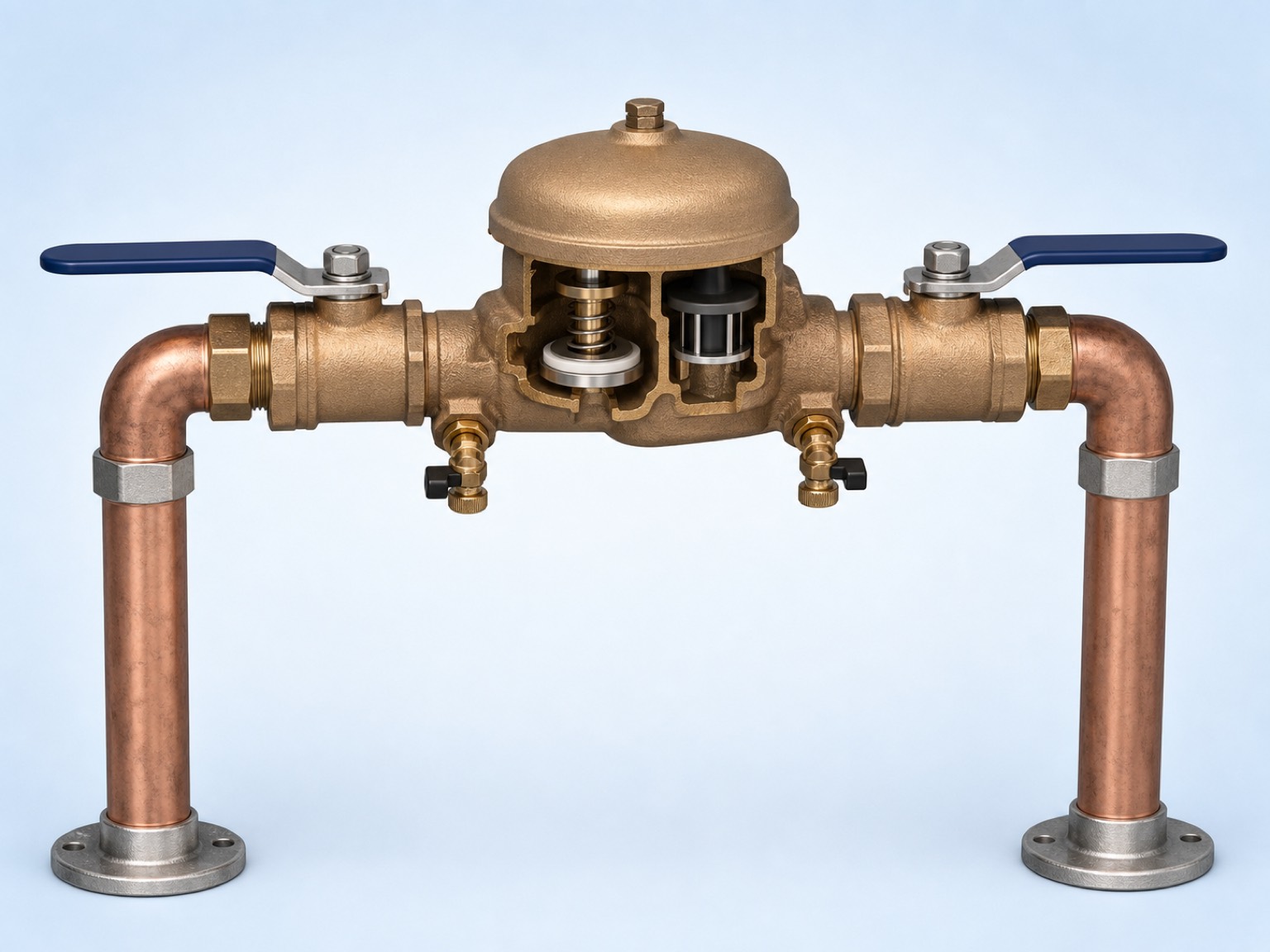
How can you identify the irrigation water source?
Start with the utility bill and notice sender. Look for a separate secondary-water account, meter, district name, or seasonal irrigation service. Trace only visible, safe piping; do not open a pressurized box or cross-connect hoses to experiment. Ask the city or district which source serves the irrigation meter and whether a recorded backflow assembly is tied to the culinary account.
On a dual system, identify the physical separation and changeover arrangement. A casual hose or valve link between secondary and culinary systems is exactly the kind of cross-connection the rules address. Riverton Code 13.10.170 bars unauthorized substances in secondary lines, and Code 13.10.350 governs testing. Other cities can use different details, so Riverton’s hardware rule should not be copied across the valley.
Which devices are common on sprinklers?
A PVB is common where protection against backsiphonage is appropriate and the assembly can remain at least 12 inches above the highest downstream outlet. An RPZ protects against backsiphonage and backpressure for higher hazards and releases water through a relief zone, so drainage matters. DC and SVB assemblies appear in approved applications with different hazard and installation limits. All 4 can be testable designs; an atmospheric vacuum breaker is generally non-testable.
The correct device is not chosen by lowest price. Elevation changes, fertilizer injection, pumps, chemical feeds, property slopes, booster pressure, indoor placement, local lists, and winter exposure affect the decision. The tester identifies what exists; the water provider and appropriately qualified installer confirm what is approved if replacement or redesign is needed.
When should irrigation testing happen?
A city notice or established due date controls. When timing is flexible, test after water is available but before peak spring irrigation so a failure does not hold up every zone. Avoid waiting until the final day: a failed check may need parts, repair authorization, a retest, and filing. A dormant winterized system may require water activation and then another drain or blowout, adding work.
After any irrigation backflow repair, test again before relying on the assembly. Riverton explicitly requires testing after repair or relocation, and KID requires immediate testing after repair, maintenance, or relocation. Even if a local summary only mentions annual testing, a repair without a passing retest leaves no measured proof that the protective function was restored.
What can make an irrigation assembly fail?
Fine debris from pipe work, mineral scale, worn discs, weakened springs, damaged test cocks, inoperable shutoffs, pressure transients, and winter freeze exposure can affect readings. A PVB installed below a downstream outlet can also be wrong for the hydraulic setup even if its internal check passes. An RPZ that discharges may be responding to a check problem or pressure condition; its relief opening must never be plugged.
Ask the tester to separate test failure from installation observation. The field test measures the assembly. An elevation, drainage, enclosure, or cross-connection issue may need a different correction and possibly another trade. Combining every observation into one unexplained “failed device” quote makes it impossible to compare repair, replacement, and piping work fairly.
How much does irrigation testing and repair cost?
For a routine residential assembly, use the northern Utah February 2026 testing range of $100–$200. National 2026 testing guides show $75–$150 or more. HomeAdvisor’s replacement figures average about $350 with a common $150–$450 range, and sprinkler units may fall from $100–$600; RPZ work, buried access, piping changes, and drainage can run higher. The service provider supplies the property quote.
Before scheduling, ask if water activation, enclosure access, multiple zones, more than 1 assembly, report filing, and a customer copy are included. If a winterized system must be activated and drained again, price that explicitly. After a failure, compare the full repair + retest + filing total with the full installed replacement + initial test + filing total.
How should the system be winterized?
Salt Lake County’s typical first frost lands around October 21–31, making October the practical blowout month. Follow the assembly manufacturer plus an official local reference such as the South Jordan guide or Salt Lake City guide. The safe sequence can involve supply isolation, drainage, test-cock positions, and compressed air downstream; it varies by assembly and layout.
Do not assume a foam cover empties water from checks and ball-valve cavities. Do not send uncontrolled compressor pressure through the backflow assembly. If a shutoff will not close, a drain is blocked, or the valve body is already split, stop and get the correct repair. Winterization should reduce freeze risk without creating a new cross-connection, overpressure, or spring startup surprise.