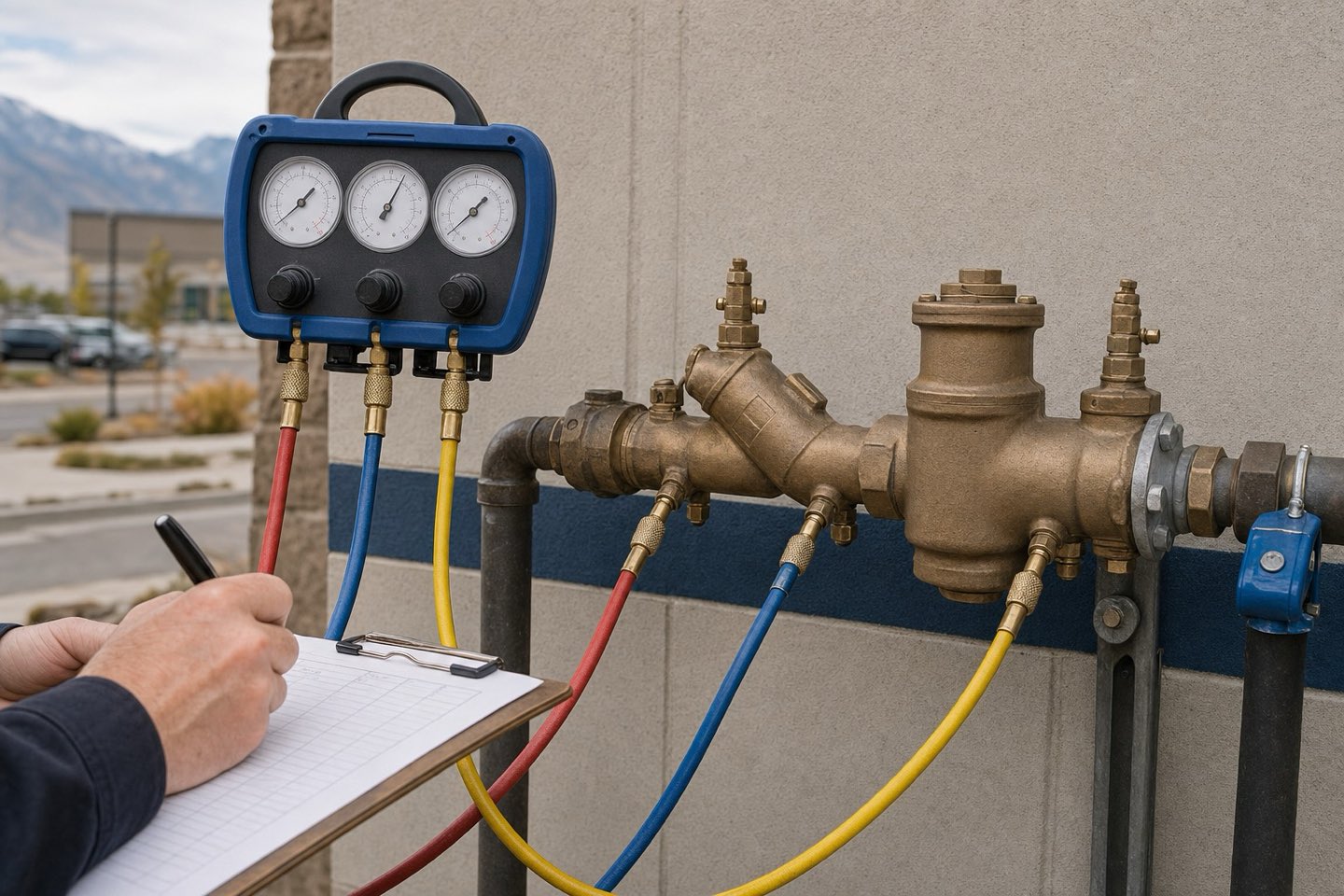
When do you need the annual test?
Schedule when the city or district notice arrives, when your existing annual record approaches 12 months, or when the water provider identifies a recorded assembly without a current result. Riverton and Kearns also publish additional triggers after repair or relocation. South Jordan requires an initial test within 10 working days of installation, then annually. Those triggers mean waiting for the next annual letter after a repair can leave the record incomplete.
For irrigation assemblies, our recommendation is to test before the system’s busiest spring use if the district allows that timing. A borderline check or freeze-damaged part is easier to address before every landscape zone depends on it. If the notice gives a different date, the notice controls. West Jordan’s published material does not establish a universal notice deadline, so call Water Operations at 801-569-5700 rather than assuming 30 days.
How long will the water be off?
A routine field visit commonly takes 20–40 minutes, with some assemblies taking up to about 1 hour when access, size, multiple devices, or troubleshooting adds time. The downstream water is shut off during the active test. For a residential sprinkler PVB, that usually affects irrigation rather than all house fixtures. A domestic, fire-line, or facility assembly can affect a larger system and needs a planned window.
Tell us before scheduling if the assembly serves a restaurant, medical use, boiler, fire system, apartment building, irrigation controller, or process that cannot tolerate an unplanned interruption. The state-certified tester confirms the shutdown boundary on site. Commercial managers should identify who can authorize valve operation and whether tenants, alarms, fire protection personnel, or another qualified trade must participate.
What should the $100–$200 testing range include?
Storm Sprinklers’ northern Utah guide, updated February 8, 2026, places residential testing at $100–$200. BackflowRates’ 2026 national guide lists $75–$150 or more. The local range should be treated as the stronger comparison for a Salt Lake Valley home, but neither figure guarantees the price for your address. Ask whether 1 device, filing, travel, and a customer copy are inside the base charge.
Also ask for the retest price, missed-access charge, after-hours premium, and any district filing fee before the appointment. Published competitors elsewhere show how totals can change: Denver schedules by device size at $125, $150, and $175 and lists separate travel or access fees. That is not Utah pricing; it is evidence that the headline test number is not enough unless inclusions are written down.
What readings should you receive?
The useful record identifies the assembly type, manufacturer or model when available, size, serial or asset number when required, location, test date, tester identity and certification information, gauge information, measured values, pass or fail result, repairs, retest result, and submission destination. The exact form differs by water provider. A receipt that says only “backflow done” is weaker than the compliance record your notice is asking for.
If the assembly fails, request the individual failed reading before authorizing work. A check valve that does not hold, an RPZ relief valve that opens at the wrong differential, and a shutoff that cannot isolate the device are different problems. The reading connects the repair to a measured condition and gives you something concrete to compare if a second opinion is needed.
Who files the annual test report?
The state-certified tester completes and files the result with the program responsible for the connection. Riverton publishes [email protected]. Kearns Improvement District explicitly says the tester submits results to KID. South Jordan records results with Public Works. West Jordan says reports are filed with the city; when a notice or account points to Jordan Valley Water Conservancy District, confirm that program instead at 801-446-2000.
Keep your own proof even when filing is handled for you. Save the completed report, email or portal confirmation if available, invoice, repair authorization, and next due date. If a notice continues after submission, those records let the city locate the device and tester without repeating a paid visit. A report can be delayed by a wrong account, device number, address, or destination, so review those fields promptly.
What happens after a pass or a failure?
After a pass, the tester restores the valves to the correct operating position, checks for obvious leakage, finishes the report, and provides or sends the result. We note the annual cycle for a reminder. A pass confirms the assembly’s tested performance at that time; it does not certify unrelated plumbing, promise a full year without damage, or override a water provider’s installation requirements.
After a failure, pause at the diagnosis. Debris, worn rubber, weak springs, freeze damage, an inoperable shutoff, or an installation problem lead to different decisions. A repair should be authorized with its retest and filing steps clear. A cracked body, obsolete device, unavailable parts, repeated failures, or a repair total near replacement can shift the value toward a new approved assembly.