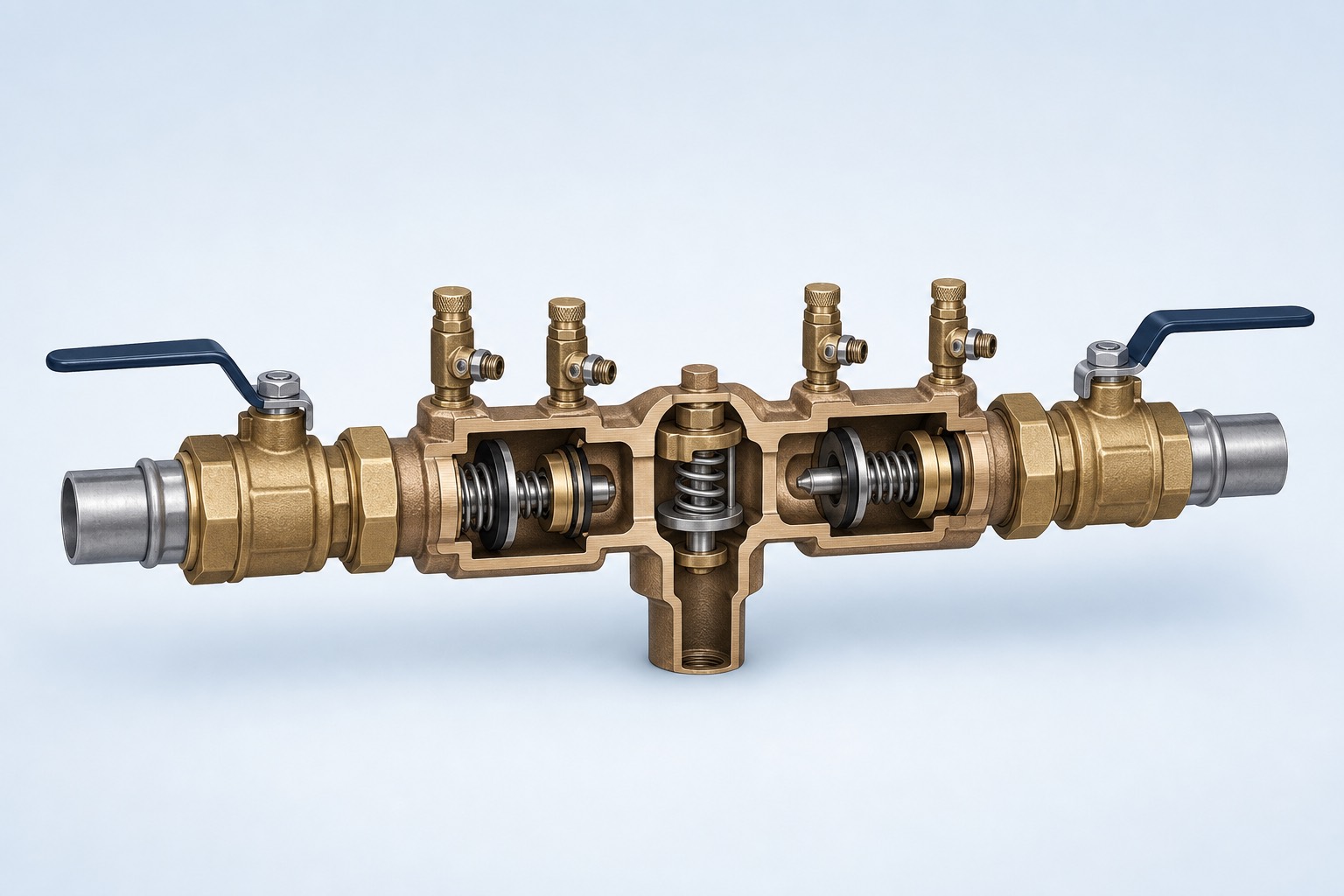
What does the failed reading tell you?
A differential-pressure test isolates each protective component. On a double-check assembly, the tester evaluates both check valves. On an RPZ, the tester also evaluates the relief valve and the pressure zone between the checks. On a PVB or SVB, the check and air-inlet behavior matter. The measured value tells you which boundary did not meet its test criterion; it is more informative than a general statement that “the valve is bad.”
Ask for the assembly type, test step, measured value, and required value on the form. If a retest later passes without repair, the record should explain what changed—such as debris being flushed during an allowed procedure—not erase the first result. A mysterious fail-then-pass sequence without readings is exactly the situation that makes homeowners distrust annual testing.
Which failures are usually repairable?
Replaceable check discs, O-rings, springs, seats, relief components, test cocks, and some shutoff parts can often be serviced in line when the body is sound and a compatible repair kit exists. Debris on a seat may be removable. The tester should identify the manufacturer, model, size, part kit, and whether the repair restores the listed assembly rather than improvising incompatible internals.
Repair is strongest when the failure is isolated, parts are available, access is reasonable, and the repair plus required retest is comfortably below a suitable installed replacement. It is weaker when several assemblies have repeated failures, a corroded shutoff prevents testing, or labor requires rebuilding most of an obsolete device. The cheapest part price online is not the full repair cost; diagnosis, shutdown, labor, calibration-based retest, and filing still exist.
When does replacement make more economic sense?
A freeze-cracked bronze body, distorted casting, unavailable repair kit, wrong device type, wrong size, unsafe access, repeated annual failures, or a repair total near the installed replacement total can favor replacement. RPZ units may also need a compliant drain or air-gap arrangement; replacing only the body does not correct a larger installation problem. The city or district and the qualified installer determine what is approved for the connection.
Use a simple comparison: repair parts + labor + retest + filing + likely remaining life versus approved device + installation + initial test + filing + any permit or plumbing work. Do not compare a $289 repair benchmark with a $350 national device average as though both include the same labor and site conditions. Put both complete written scopes side by side.
What do published 2026 prices say?
WaterCrest in Austin published $289 for repair of a 1/2- to 3/4-inch device in the July 2026 competitor snapshot. A northern Utah guide says residential parts can start around $250 and commercial work can reach into the thousands. HomeAdvisor’s June 20, 2026 national data gives about $350 average and $150–$450 for preventer installation or replacement, with sprinkler or sewer units at $100–$600 and RPZ replacements often higher.
Those numbers are anchors, not a West Jordan price list. Device size, body material, manufacturer, parts availability, access, shutoff condition, drainage, required plumbing license, testing, filing, and an emergency leak all affect the written quote. The useful number is the total to reach a passing filed result, not the price of one rubber kit or bare valve on a retail shelf.
How should repair authorization work?
First, the tester records and explains the failure. Second, you receive a written repair scope with the part or component, labor, retest, filing, and possible additional conditions. Third, you authorize or decline. The repair is not hidden inside the original testing consent. If the body is leaking actively or the system cannot be restored safely, the tester explains the immediate water-control need and the qualified party required.
After authorized repair, the assembly is tested again. Kearns Improvement District explicitly requires immediate testing after repair, maintenance, or relocation; Riverton requires testing after repair as well. Even where a city summary only states annual testing, the repaired device needs a passing result before the compliance record is complete. Ask for both the failed and passing values.
Can winterization prevent the same failure next year?
Freeze damage is unusually important along the Wasatch Front. Salt Lake County’s typical first-frost window is around October 21–31, so irrigation blowouts are commonly scheduled in October. Water trapped in a bonnet, check cavity, ball valve, or exposed riser can expand and crack components. Insulation alone is not a substitute for the device-specific drain and valve sequence.
Use the official South Jordan winterization guide or Salt Lake City backflow winterization guide as a starting reference, then follow the assembly manufacturer’s instructions. A late blowout, a closed valve that traps water, or compressed air sent through an unsafe path can create the failure winterization was meant to avoid.