What does the 10-working-day rule cover?
The published South Jordan rule applies after initial installation: test within 10 working days, then follow the annual cycle. “Working days” is more specific than a generic 10-day countdown and should not be rewritten as 2 calendar weeks. A replacement may be treated as a new installation or repair event; confirm the city’s current expectation before work closes.
Keep the installation invoice, device model and serial, initial passing result, and city recording proof together. If the installer and tester are different qualified parties, make sure the tester receives the final device information and filing destination rather than assuming the installation permit finishes the test record.
What should a South Jordan homeowner send when scheduling?
Send the notice header, service address, due date, assembly photo, device size if visible, and whether the system uses culinary or secondary water. Mention a recent replacement, irrigation redesign, leak, freeze event, or failed prior test. The state-certified tester we send performs the test and records the result; clear information helps the report match South Jordan’s inventory.
A routine residential visit commonly takes 20–40 minutes. Ask whether the $100–$200 northern Utah residential comparison includes the field test, filing with Public Works, and a customer copy. The written quote comes from the service provider after access, device count, and condition are known.
How should South Jordan irrigation be winterized?
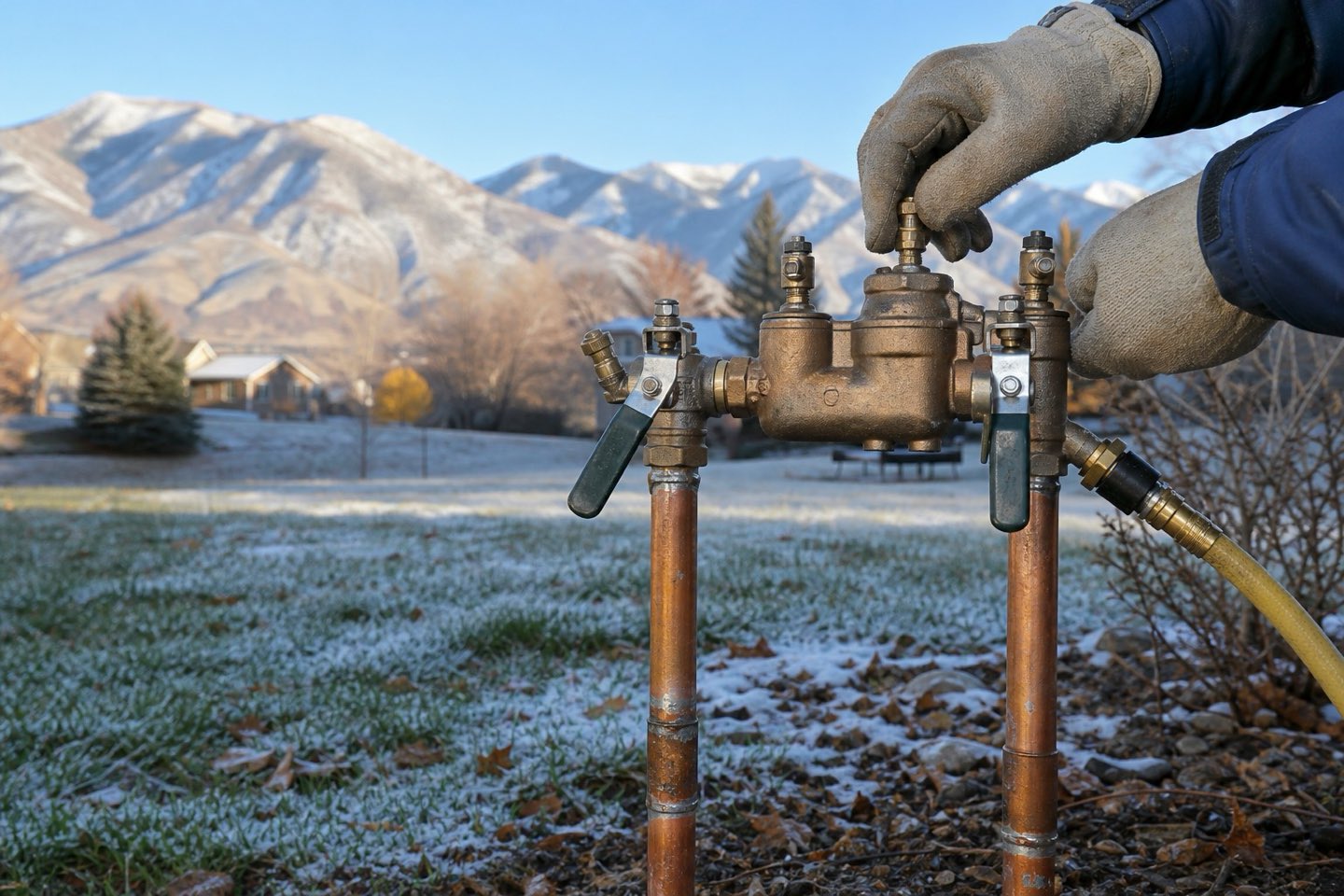
South Jordan publishes its own sprinkler and backflow winterization guide, which is stronger local guidance than a generic social-media checklist. Salt Lake County’s typical first-frost window is around October 21–31, so October is the practical blowout window. Follow the city guide plus the manufacturer’s instructions for the specific PVB, RPZ, DC, or SVB.
Do not rely on insulation alone or force compressor air through an unknown valve path. Water trapped in ball valves, test cocks, check cavities, or risers can freeze and create a spring failure. If a shutoff will not isolate or drain correctly, resolve that before the first hard freeze rather than discovering the damage at spring testing.
Who receives the result and what proof should you keep?
South Jordan says results are recorded with Public Works. The tester should use the city’s current accepted form and route, then give you a copy or submission confirmation when available. Review the address, assembly identification, date, readings, tester certification information, and pass or fail status before storing it.
Keep at least the current and prior annual result, plus every repair and passing retest pair. If a city notice continues after filing, call 801-446-4357 with the device serial, test date, and tester name. A traceable report can resolve an account mismatch; a receipt with no readings cannot.
What happens if the South Jordan device fails?
Ask to see the failed pressure reading before authorizing a repair. Debris, rubber discs, springs, shutoffs, freeze damage, or installation conditions require different work. The quote should separate repair, replacement when relevant, retest, and filing. A repaired assembly needs a passing measurement before the city record is complete.
Use the 2026 price anchors carefully: $100–$200 for a northern Utah residential test, about $350 average and $150–$450 common nationally for replacement, and higher totals for RPZ, access, or plumbing changes. These are comparisons; the service provider supplies the South Jordan written quote.