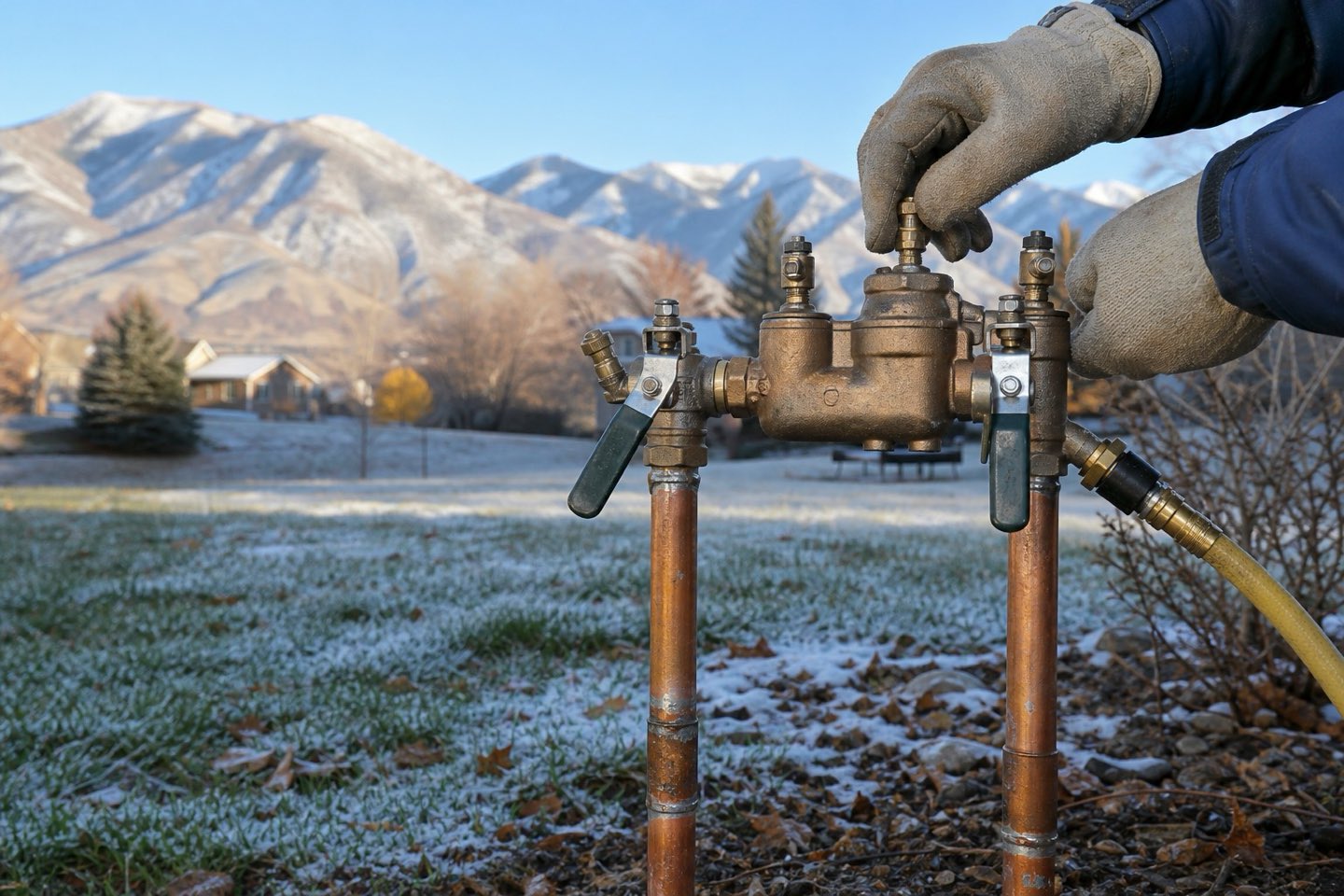
When should you schedule the blowout?
Local guidance places Salt Lake County’s usual first frost around October 21–31, and sprinkler blowouts commonly happen in October. Do not interpret the average window as a guarantee; an earlier cold night can arrive. Schedule with enough margin for a missed appointment, inaccessible valve, failed shutoff, or repair rather than choosing the last open slot before Halloween.
If the annual backflow test is also due in fall, coordinate the order. The device needs water for testing, but winterization removes water. Testing first and winterizing afterward can avoid a second activation. If a city date falls after winterization, tell the scheduler so the quote includes safe activation and re-winterization rather than an unexpected extra visit.
What do the official local guides say?
South Jordan publishes a city winterization guide, and Salt Lake City Public Utilities publishes a backflow winterizing guide. Use them as authoritative local references alongside the manufacturer’s manual for your model. A PVB, RPZ, DC, and SVB do not share one identical drain and valve sequence.
A city guide cannot see an improvised bypass, buried valve, missing drain, dual culinary/secondary connection, or commercial process. If the visible piping differs from the diagram or a valve will not operate normally, stop and identify the assembly before applying compressed air. The goal is controlled drainage, not simply making air come out of sprinkler heads.
Where should compressed air connect?
Use a designated downstream blowout connection that keeps uncontrolled compressor pressure from traveling through the backflow assembly. Regulate pressure for the irrigation components and move through zones according to qualified guidance. Never improvise by attaching to a test cock simply because its threads fit a hose. Test cocks are measurement ports, not universal compressor fittings.
Keep people and pets away from sprinkler heads during blowout. Stop if a zone does not open, pressure climbs unexpectedly, fittings move, or the assembly discharges in an unfamiliar way. Compressed air stores energy and can damage pipes, valves, rotors, and drip components when treated as a brute-force solution.
How should exposed valves and test cocks be left?
Follow the exact manufacturer and city sequence. Many winterization procedures position ball valves and test cocks partly open so water is not trapped behind a closed ball, but the correct angle and order depend on the assembly and installation. Record the final winter position and add a spring startup note so those valves are restored before normal water use.
Do not cap an RPZ relief opening, fill a bonnet with antifreeze, or apply an unlisted heater. Insulation must remain dry, avoid fire risk, and leave inspection and discharge paths clear. A cover can supplement correct drainage; it cannot make a water-filled casting freeze-proof.
What freeze damage looks like in spring?
Warning signs include a hairline body crack, water from a seam, split bonnet, damaged test cock, shutoff-stem leak, persistent RPZ discharge, missing pressure, or a device that will not pass its checks. Some internal disc or spring damage is invisible until the certified test. Do not plug a leak path or force a stiff valve to get irrigation running.
Photograph the source and shut off water only when you know the correct safe isolation. A state-certified tester can measure the assembly; a cracked body or piping repair may require another qualified professional. Ask for the complete repair + retest + filing or replacement + initial test + filing total before choosing the spring fix.
What does winterization cost relative to repair?
The fact pack does not provide a verified Salt Lake Valley blowout price, so no invented range is published here. Ask the service provider to separate irrigation blowout, backflow-specific drainage, annual testing, water activation, repair, and a return visit. One bundled “winter service” label can hide whether the protective assembly was actually addressed.
The economic reason to act is visible in repair data: northern Utah residential parts can start around $250, a published small-device repair example is $289, and national replacement averages about $350 with a common $150–$450 range before more complex RPZ work. Early drainage is cheaper than treating a cracked body as an unavoidable spring surprise.