What do the 4 common testable assemblies look like?
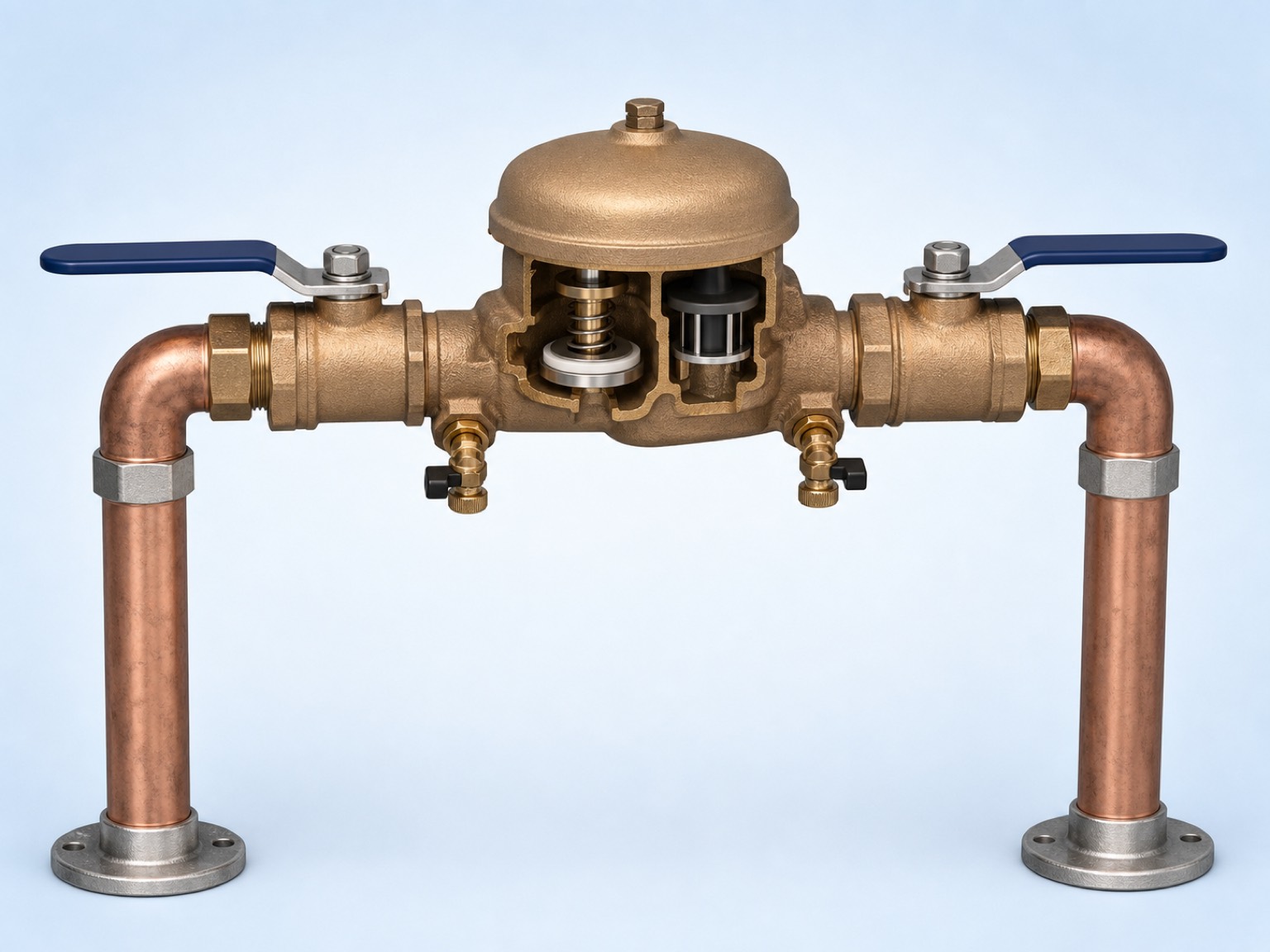
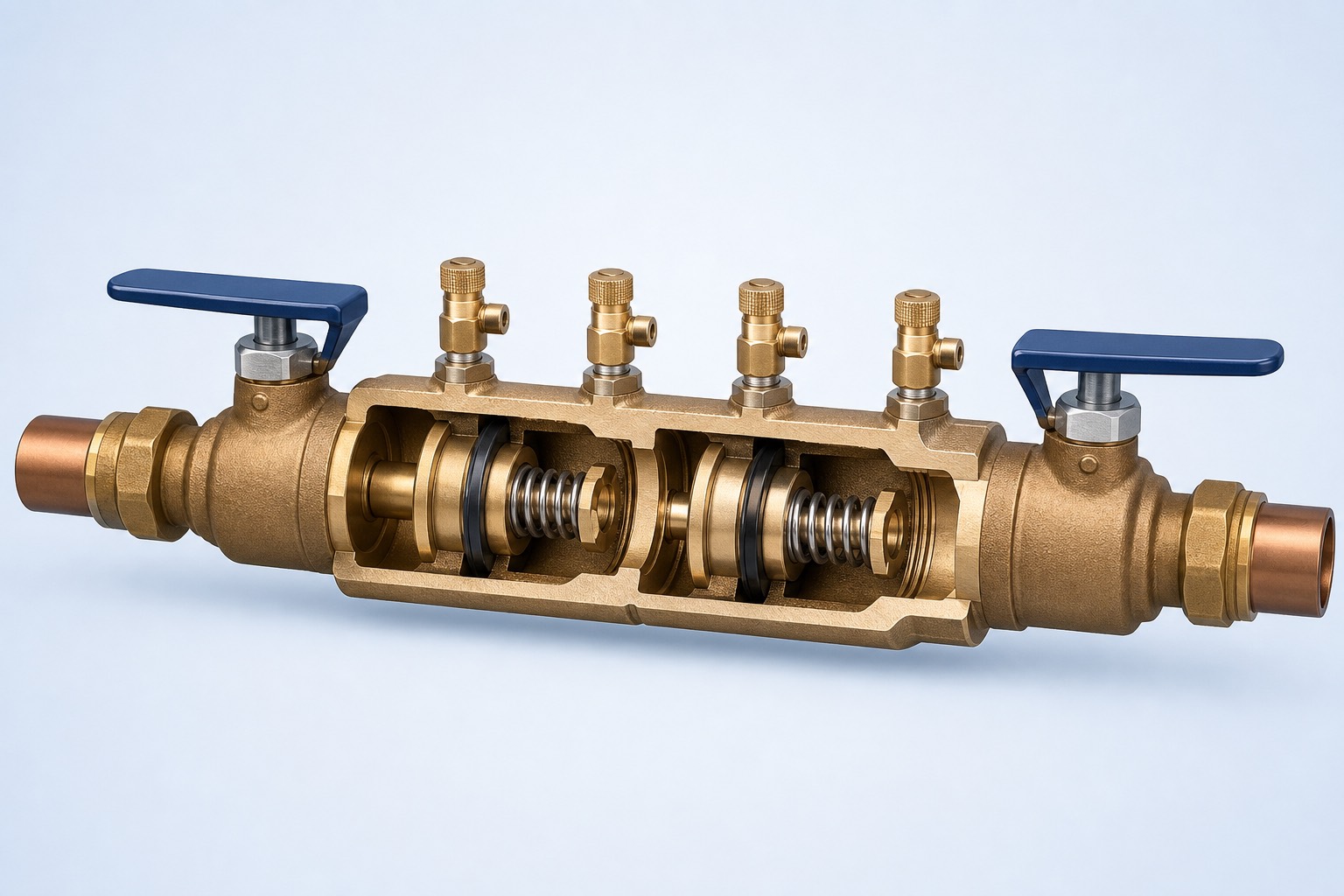
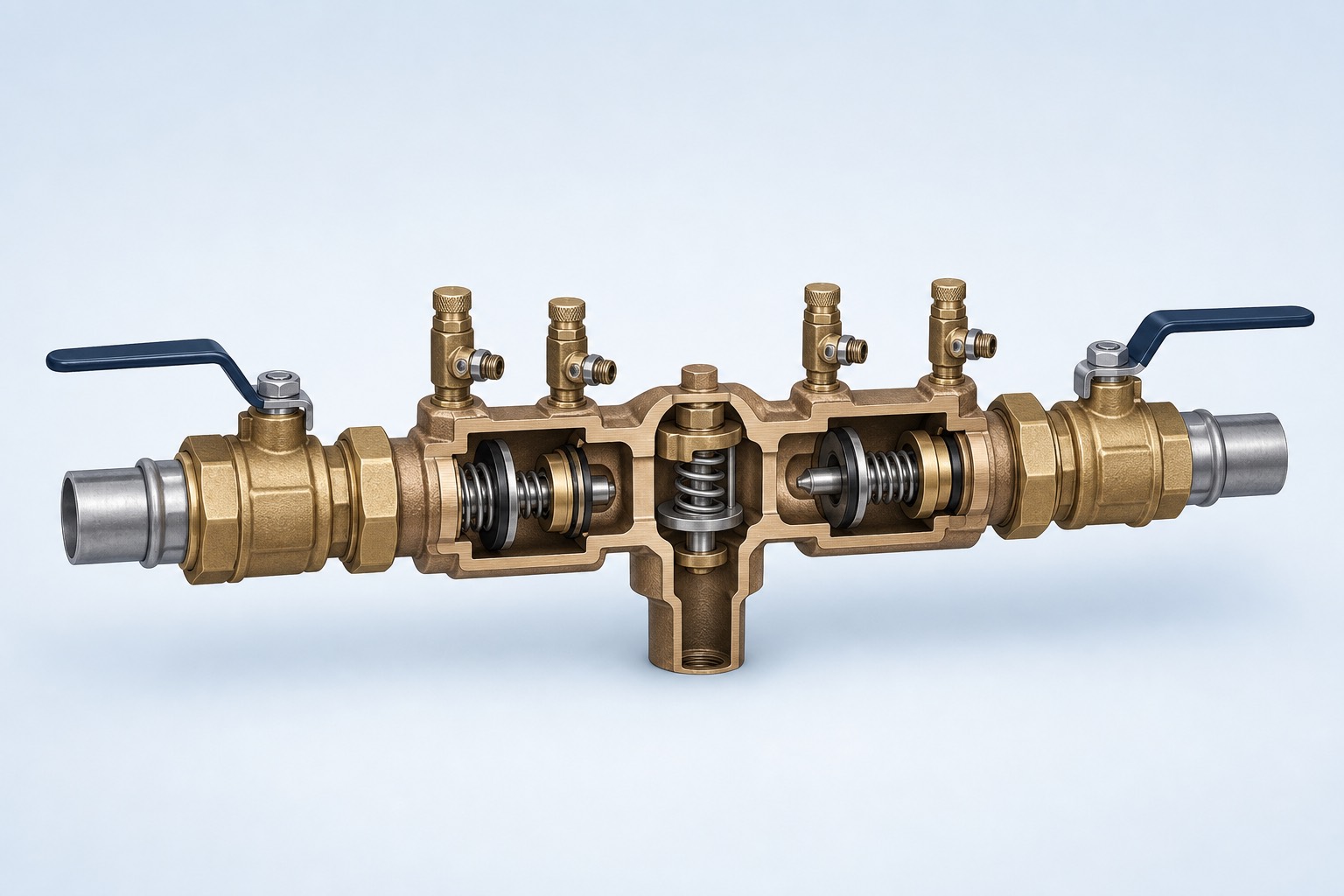
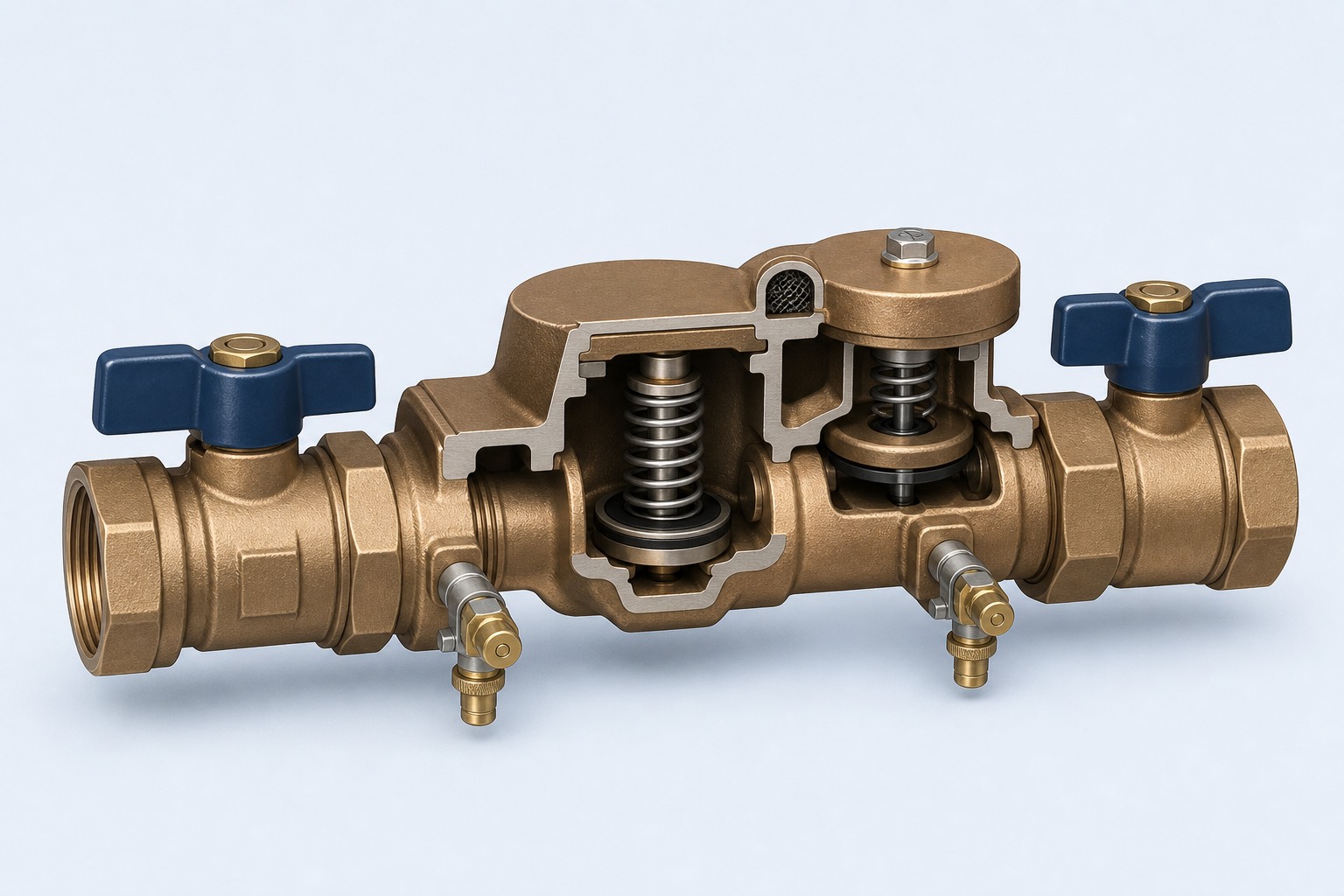
PVB means pressure vacuum breaker; DC means double-check valve assembly; RPZ or RP means reduced-pressure principle assembly; SVB means spill-resistant vacuum breaker. All 4 have testable designs, but they are not interchangeable. The illustrations below are educational, unbranded cutaways generated from real assembly forms, with the names and limits kept in HTML so the labels remain readable on a phone.
How does a PVB work and where does it fit?
A PVB combines a check valve with an atmospheric air inlet. During a backsiphonage condition, the check closes and the air inlet opens so the downstream line cannot pull water toward the supply. It does not protect against backpressure. Standard installation guidance places it at least 12 inches above the highest downstream outlet, which is why residential sprinkler PVBs often sit visibly on 2 risers.
Look for the central bell-like bonnet, 2 shutoff valves, and 2 small test cocks. A PVB can spill during startup or a fault, but it should not have the distinct bottom relief zone of an RPZ. Elevation, continuous-pressure rating, freeze exposure, and local approval must be confirmed for the exact model.
What separates a DC from an RPZ?
Both use 2 check valves and can protect against backsiphonage and backpressure within their approved applications. A DC has no monitored relief zone and is generally used for lower-hazard conditions. An RPZ places a reduced-pressure zone and relief valve between the checks, providing high-hazard protection and a visible discharge path when pressure relationships are wrong.
A DC often appears as a straight body with 4 test cocks. An RPZ adds a relief chamber or downward opening and needs safe drainage. Never cap an RPZ outlet to stop a leak. The discharge can be evidence of debris, a failed check, or a pressure condition that needs a test—not proof that the relief opening should be defeated.
When is an SVB used?
A spill-resistant vacuum breaker combines a spring-loaded check and air-inlet arrangement intended to reduce nuisance spillage while protecting against backsiphonage in approved continuous-pressure applications. It usually has 2 test cocks and a more compact, lower bonnet than a traditional PVB. It does not provide the backpressure and high-hazard protection of an RPZ.
Because PVB and SVB bodies can look similar from a poor photo, read the model tag. A product category should not be inferred from handle color. Confirm required elevation, orientation, pressure use, drainage, and local approval before replacement. A lower-profile silhouette is a clue, not a specification.
Which devices are not field-tested like these assemblies?
Atmospheric vacuum breakers, swing checks, and some dual checks are non-testable devices. Hose-bib vacuum breakers protect individual outdoor faucets and West Jordan’s water-quality report recommends them, but they do not replace a testable assembly on a recorded irrigation connection. An air gap is a physical separation; KID says air-gap setups receive visual checks rather than gauge tests.
If a notice says a testable assembly exists but you find only a hose-bib device or air gap, ask the program to identify its recorded device and location. Do not bolt test cocks onto a non-testable valve or assume visual condition equals performance. The protective method and required verification must match.
How does Utah secondary water change the answer?
First identify whether irrigation uses culinary drinking water, secondary non-potable water, or both. West Jordan’s published annual-testing statement addresses landscape sprinklers connected to public drinking water. A secondary-only system can follow another configuration. The existence of irrigation does not prove the source, and a green box or seasonal schedule is not enough to identify the account.
Riverton publishes the clearest dual-water example: an RPZ on the culinary side plus a swing joint; secondary-only connections require removing the culinary stop-and-waste. That is a Riverton rule, not automatic valley-wide hardware. Ask the actual water provider to confirm the connection before choosing a device or deciding no test applies.