Is the backflow letter real?
Usually, yes. Utah Admin. Code R309-105-12 requires testable backflow assemblies to be inspected and tested at least once a year by a certified individual. West Jordan also says landscape sprinklers connected to public drinking water need an approved assembly and annual testing. A notice can still contain an error, so verify the sender, service address, assembly record, and due date before paying anyone.
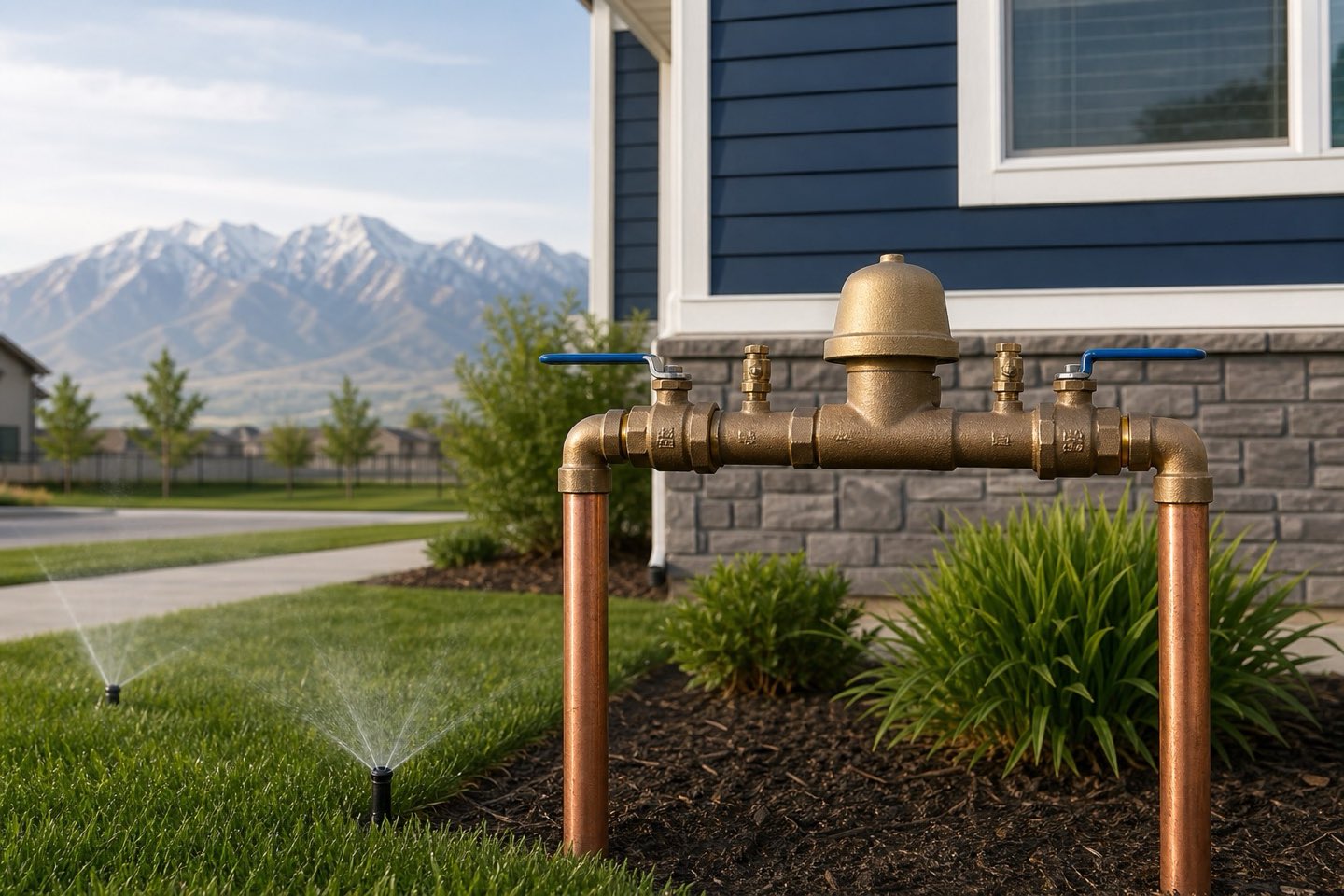
The letter is about the brass valve between drinking water and a possible contamination path—most often a culinary-water sprinkler system. A pressure loss from a main break or hydrant use can pull water backward. A pump, boiler, or elevated system can push it backward. The assembly is the mechanical barrier, and the annual field test checks whether its internal valves still hold the required pressure difference.
Verify the sender
Match the city or district name to an official website, then call the published number—not a number added by a door-to-door seller.
Verify the tester
Use Utah’s WaterLink commercial tester lookup and match the person who will perform the test.
Verify the deadline
West Jordan’s exact notice deadline is not published in the available city material. Call Water Operations at 801-569-5700.
Verify the price
Ask for the testing price, filing charge, travel fee, retest fee, and repair authorization rule in writing before the visit.
Why did I get a letter when my neighbors did not?
A water provider’s inventory is tied to recorded assemblies and cross-connections, not simply to every house on a street. Your property may have a culinary-water irrigation connection while a neighbor uses secondary water, has a different device record, or receives service from another district. A newly reconciled record can also explain why the first notice arrives after many quiet years.
Do not assume the notice is false because only one mailbox received it. First identify the water provider printed on the notice and the device at the property. In West Jordan, the city is the retail water utility, while Jordan Valley Water Conservancy District runs a separate backflow program for its own metered connections. The correct filing destination follows the account and connection—not the nearest city name.
How much should a backflow test cost in 2026?
A northern Utah cost guide published February 8, 2026 puts a residential backflow test at $100–$200. A 2026 national specialist guide gives $75–$150 or more. Those are comparison ranges, not a quote for your address. Device size, number of assemblies, access, travel, filing charges, and a return visit can move the total. The written quote comes from the service provider.
Our position is simple: a city mandate should not hide the price. Before we schedule, ask what the base test includes and what can be added. If the assembly fails, the tester should show you the failed pressure reading before presenting a repair quote. Testing, repair, retesting, and filing should appear as separate line items when they are separate charges. See the full pricing guide for sourced comparisons.
What happens during the 4-step process?
Step 1 is a call or form with the notice sender, due date, property ZIP, and assembly type if you know it. We arrange the appointment. Step 2 is the field visit: the state-certified tester we send isolates the downstream side, connects a calibrated differential-pressure gauge to the test cocks, and records how the check valves and relief valve respond. A routine visit commonly takes 20–40 minutes.
Step 3 is filing. The tester completes the accepted report and sends it to the city or district responsible for the connection. Step 4 is proof: keep the result, submission confirmation, invoice, and any failed readings together. We also note the annual cycle so next year’s requirement is a reminder rather than a surprise. If a repair occurs, some districts—including Kearns Improvement District—require another test immediately afterward.
What if the assembly fails?
A failed test is a measurement, not automatic permission to replace the entire device. Debris can prevent a check from seating. Rubber discs can harden or crack, springs can weaken, and Utah freezes can split a valve body. The tester should identify which component missed its required reading and explain whether cleaning, an internal repair kit, or replacement is the sensible branch.
For a repairable small assembly, one published Austin example lists $289 for a 1/2- to 3/4-inch repair. National 2026 replacement guides average about $350 and commonly show $150–$450, with some sprinkler units from $100–$600 and RPZ work often higher. These are benchmarks, not Salt Lake Valley quotes. Compare repair plus retest with a complete installed-and-tested replacement, expected part availability, and freeze damage.
Which city or water district handles my report?
West Jordan says the city notifies owners and receives reports; call Water Operations at 801-569-5700 when the notice mechanics are unclear. South Jordan records annual results with Public Works. Riverton publishes an email route at [email protected]. Most of Taylorsville/Bennion is administered by TBID, not the city. Midvale names its program administrator, and KID says the certified tester submits the result.
The fastest way to avoid a lost filing is to send a clear photo of the notice header when requesting service. The tester can match the account, assembly serial information, and report destination before leaving. If the property has multiple water accounts, irrigation meters, fire lines, or more than 1 assembly, list them separately. Our reporting guide has the district-by-district summary.
Which backflow service do you need?
Start with the task that created the deadline. Annual testing fits a passing device that is simply due. Residential and irrigation testing address home sprinkler connections; commercial testing adds assembly inventories, access windows, and multiple reports. Repair begins only after a failed reading. Replacement is the branch for a cracked, obsolete, wrongly sized, or uneconomical device. Reporting support is for a completed test that still needs the correct destination or proof.
Annual testing
Schedule the yearly field test, result explanation, filing, copy, and reminder. Annual testing details.
Repair or replacement
See the failed reading first, then compare the repair-and-retest total with replacement. Failure economics.
Home and irrigation
Identify whether the sprinkler system uses culinary water, secondary water, or both. Irrigation guide.
Commercial properties
Coordinate access, shutdown authority, device inventory, and each filing destination. Commercial testing.
Where do nearby city rules differ?
South Jordan, Riverton, Taylorsville, Midvale, and Kearns do not share one filing playbook. Riverton Code 13.10.350 makes testing the owner’s responsibility and requires testing at installation, repair, relocation, and annually. South Jordan requires an initial test within 10 working days. KID calls for immediate testing after repair and treats an air gap as a visual-check setup. TBID publishes enforcement authority but not the notice deadline we could verify.
Use the city guides for the administrator, rule number, phone, filing method, and verified boundaries. Where the deadline is not in published material, the guide says so and gives the official number. We do not turn an unverified “30-day” figure from a forum into a local fact.
South Jordan
Municipal Code §13.04.370, 10-working-day initial test, annual records, and a city winterization guide.
Riverton
Code 13.10.350, email filing, owner responsibility, and the culinary-side RPZ rule for dual-water connections.
Taylorsville
TBID runs the program for most of Taylorsville/Bennion and publishes its own tester list.
Midvale and Kearns
Midvale names Bryton Mecham; KID names John Lawson and publishes post-repair and air-gap rules.